
Asking what a website costs is a lot like asking what a house costs. A three-bedroom starter home and a custom build on the lake are both “a house,” and they can be millions of dollars apart. Nobody can price one until they know how many rooms it has, where it sits, and whether the counters are laminate or granite.
Websites work the same way. The price follows the details, and most of the details get settled before anyone designs a thing. This guide covers what small business websites actually cost in the United States, why the prices land where they do, and what you get and give up with each kind of provider, from building it yourself to hiring a large agency.
What’s the average cost of website design for a small business?
There isn’t one average that means much, because the range is so wide. These are the typical ranges across the industry sources we reviewed for 2026:
- Build it yourself on a website builder: roughly $200 to $1,000 a year in plan fees and add-ons, plus your own time
- Freelance designer: roughly $1,500 to $8,000 for a brochure site
- Boutique agency: roughly $6,000 to $25,000
- Mid-size agency: roughly $15,000 to $60,000
- Large agency: $40,000 to $150,000 and up
Clutch, which collects reviews of design firms, reports that most web design projects reviewed on its site cost under $10,000, while the average lands above $38,000 because a few very large projects pull it up. The gap between those two numbers tells you a lot: most small businesses spend in the low five figures or less, and a handful of big builds make the “average” misleading.
Why websites cost what they do
A website is mostly skilled labor. The U.S. Bureau of Labor Statistics puts the median wage for web developers at about $45 an hour, and about $50 an hour for web and digital interface designers (May 2025). That’s what a studio pays an employee.
Design firms bill more than that, typically $100 to $149 an hour according to Clutch, because the hourly rate also has to cover payroll taxes and benefits, software, project management, revisions, and all the hours that never show up on an invoice, like sales calls and training. Freelancers charge less because they carry less of that overhead, and they also have less backup when things go sideways.
So when two quotes are far apart, the difference is usually hours: how many people will touch the project, and for how long.
What pushes the price up or down
Every credible pricing guide lists roughly the same cost drivers.
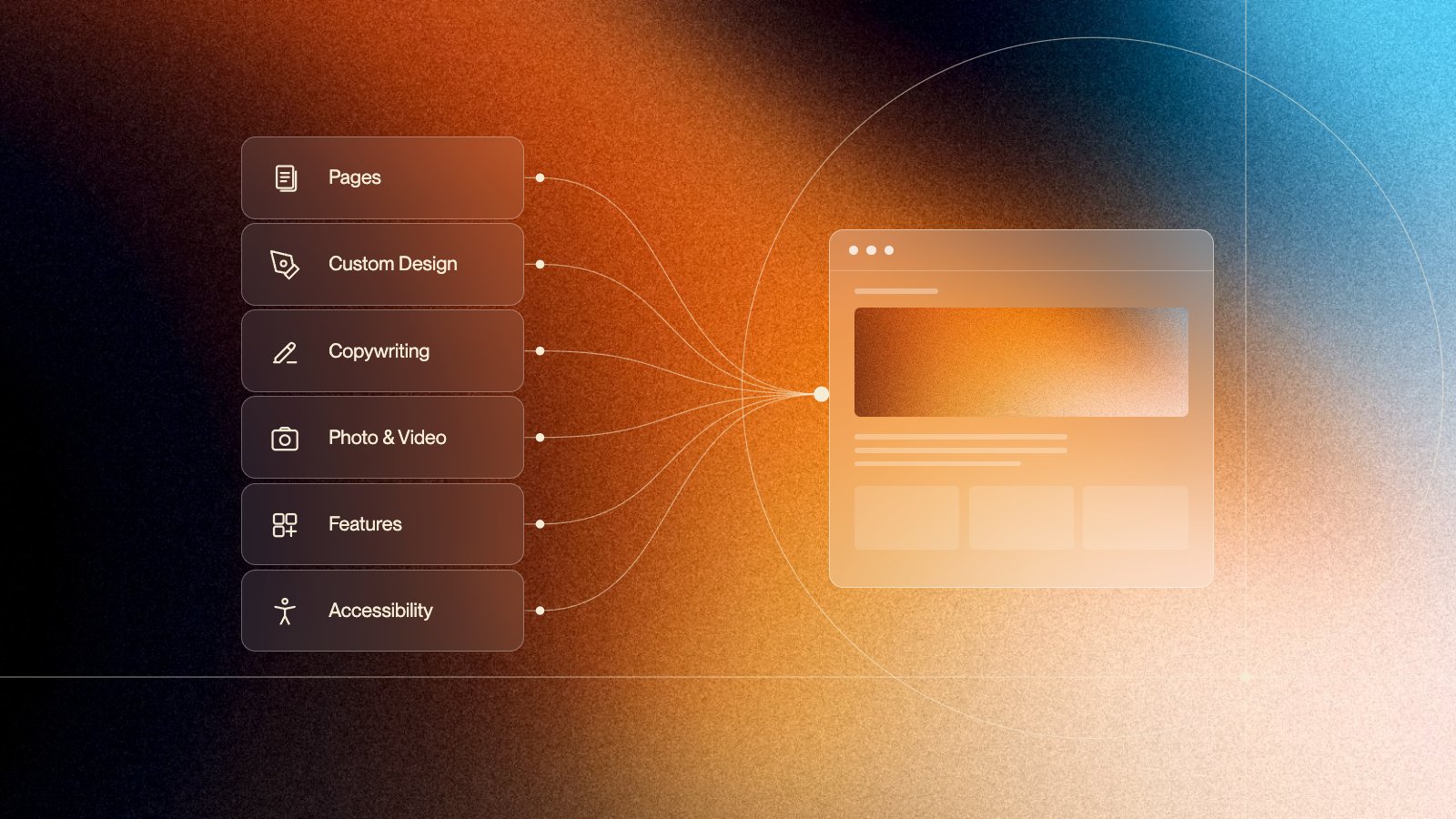
- Number of pages and how different they are from each other
- Template versus custom design
- Copywriting, and whether you write it or someone skilled does
- Photography, video and graphics
- Features like booking, ecommerce, member logins or integrations with other software
- Search optimization, both on the site and in the content
- Accessibility work
- How many rounds of revisions and decisions it takes to get to done
In our experience, what it takes to tell your story well moves the price more than page count does. If a stock photo does the job, that’s one cost. If the right way to show your business is a filmed customer interview or a custom animation, that’s a very different cost. Content is also the cost owners most often underestimate. One agency pricing study puts copywriting alone at $500 to $2,000 and photography at $300 to $1,500 for a small business site.
The cheapest place to save is usually features you want but your customers don’t. If a planning session shows that your ideal customers don’t care about a section you love, cutting it saves money without hurting results. Cutting accessibility, security or copy quality tends to cost more later.
Your five options, compared
Build it yourself
Website builders like Squarespace and Wix run about $17 to $160 a month depending on the plan.
The upside is cost and control. You can launch this week and change it whenever you like. The downside is your time, and the fact that the design, the writing and the strategy are all on you. A template’s demo looks great because it was built around its own photos and words. Once your content is a different length or shape, it rarely looks like the demo.
Best for: brand-new businesses testing an idea, or anyone who needs something live now and plans to invest later.
Freelance designer
Freelancers charge anywhere from about $30 to $200 an hour, and a small business site usually lands between $1,500 and $8,000.
A good freelancer can be excellent value, and you work directly with the person doing the work. The risks are range and capacity. One person rarely covers design, development, copy, photography and search equally well, and if they get sick, busy or leave the business, your site can be stranded.
Best for: straightforward sites with the content already written, where you have time to manage the project.
Boutique agency
Boutique agencies are small teams, and most small business sites from them land between $6,000 and $25,000. Our own projects, for example, usually start with a range of about $12,000 to $20,000 for a 10 to 20 page site, and we give a fixed quote once planning is done.
You get a team (strategy, design, development and writing) while still working closely with the people doing the work. The tradeoff is that you pay more than a freelancer, and the best boutique studios book up.
Best for: established businesses that need the site to bring in customers and want strategy and craft without big-agency overhead.
Mid-size agency
Mid-size agencies bring larger teams and more specialists. One 2026 pricing study puts their senior developers at about $195 to $300 an hour. Projects commonly run $15,000 to $60,000. Few sources separate them cleanly from boutique studios, so treat that range as rough.
You get depth and process. You may also get more layers between you and the people doing the work.
Best for: growing companies with several decision makers, larger sites, or complex integrations.
Large agency
Large agencies typically start around $40,000 and often go well past $150,000. They’re built for enterprise brands, big campaigns and complex systems.
For most small businesses, they aren’t the right fit. You’d be paying for account teams, research departments and capacity you won’t use, and a small account may not get the senior attention you’d expect.
Best for: large companies with large budgets, multiple markets and complex technology.
Does a website cost more in Georgia or Atlanta?
Not by much, based on the data. Bureau of Labor Statistics figures for the Atlanta metro show web developers earning about the same as the national median, around $45 an hour, while web and digital interface designers earn a bit more, about $57 an hour (May 2025). Among the Atlanta web design firms listed on Clutch, most bill between $100 and $199 an hour, and most list minimum projects of $5,000 to $25,000. Some local agencies claim Atlanta runs 10 to 20 percent above the national average, but we didn’t find data that supports that.
Costs after launch
The build is only part of the cost. Plan for:
- Domain: about $10 to $35 a year
- Hosting: about $5 to $20 a month for basic plans, more for managed or ecommerce hosting
- Maintenance and security: updates, backups and monitoring run roughly $600 to $6,000 a year depending on how hands-on it is
- Content and search: new pages, articles and search work are often monthly, if you want the site to keep bringing in customers
One industry survey suggests budgeting 150 to 200 percent of the build cost over the first two years once ongoing work is included. That’s one firm’s estimate, but it’s a useful reminder to ask every provider what happens after launch.
What cheap websites usually leave out
A low price usually means something was skipped. These gaps show up most often.
- Planning. Without time spent learning who your customers are and what your competitors do, the builder guesses. The site ends up talking to the wrong people about the wrong things.
- Accessibility. A 2026 scan of the top one million home pages by WebAIM found detectable accessibility failures on 95.9 percent of them. It matters legally, too. Seyfarth Shaw counted 3,117 federal website accessibility lawsuits in 2025, up 27 percent from the year before, and UsableNet reports that 64 percent of companies sued had under $25 million in annual revenue. This isn’t only a big-company problem.
- Copy that works with the design. Copy written from the inside tends to list features. Customers want to know how you’ll solve their problem. There’s also a practical issue: if one service description is a single line and the next is three paragraphs, no layout will make that look intentional. Good copy and good design get planned together.
- Custom pieces. Stock photos and template sections can’t show what makes your business different. That said, custom alone isn’t a guarantee. A handmade table can still wobble. The quality comes from the thinking behind the build.
The most expensive website is often the cheap one that doesn’t do its job, because you pay for it and then pay again to replace it.
How to get a quote you can trust
A reliable quote comes after a real conversation about your business: who you serve, what you sell, who you compete with, and what your best customers care about. That planning step tells the designer what pages you need, what content has to be created, and what can be left out.
If you get a firm number in the first five minutes, ask what it includes. If you get a range first and a fixed quote after planning, that’s a good sign the price reflects your actual project.
Start with what the site needs to do
Before comparing prices, decide what the website is for. A site built to grow a business from $1 million to $5 million in sales is a different project from one that shows off a legacy, or one that proves a speaker or consultant is worth booking. Each goal changes what the site needs, and each changes the price.
So skip “how much will a website cost?” for a minute and answer “what do I need this website to do?” Once that’s clear, the quotes you get will make a lot more sense.
Sources
- Clutch, Web Design Pricing Guide (2026)
- Clutch, Atlanta web designers listing (Sept 2026)
- U.S. Bureau of Labor Statistics, Occupational Employment and Wages, May 2025 (web developers; web and digital interface designers; Atlanta-Sandy Springs-Roswell metro)
- Squarespace pricing (2026)
- Wix plans (2026)
- Fiverr, web designer costs guide (2026)
- Elementor, small business website cost (2026)
- GruffyGoat, small business website cost (2026)
- Studio Mesa, small business website cost in 2026
- digitalapplied, website development cost 2026
- GoodFirms, website construction cost survey (2026)
- HubSpot, how much a website costs (2024)
- Trajectory Web Design, website cost in Atlanta (2026)
- Forbes Advisor, how much does a website cost (2026)
- WebFX, website maintenance pricing (2025)
- WebAIM Million (2026)
- Seyfarth Shaw, website accessibility lawsuit filings 2025
- UsableNet, ADA web lawsuit trends 2026