
I get this question a lot now. A business owner opens ChatGPT, asks it to build a website, and wonders if they just saved themselves ten thousand dollars.
The honest answer is yes, AI can build you a website. It will be live. It will have pages, a menu, some stock-looking visuals, and copy that reads fine at first glance.
Whether that website helps your business grow is a separate question. After years of building sites for small businesses, I’m not convinced it does. I want to walk you through why, as plainly as I can.
Try This Before You Ask AI for a Website
Ask ChatGPT about a subject you know deeply, like your own trade or the questions your customers ask you every week. You’ll probably get frustrated, because the answers feel shallow.
Then ask it about a subject you know little about. Suddenly the answers feel magical and insightful. Sometimes that’s only because you can’t tell the answers aren’t great in that category either.
Website strategy sits squarely in that second bucket for business owners who haven’t done it before.
Can ChatGPT Build a Website?
When a small business owner sits down with ChatGPT and asks for a website, the tool starts off strong. It asks questions about your brand, your company, your design direction, your site map, your messaging.
On the surface, that feels like real discovery work. It feels like what an agency would do with you in a strategic brand discovery meeting.
Then you take the output and try to turn it into a real site, and in what I’ve seen, the result looks very default. Predictable styles. Predictable visual direction. Everything based on defaults the model already knows, rather than a deep dive into what your customers are actually looking for.
That’s the core issue. AI mostly pulls from patterns it already knows. It cannot talk to the actual humans who will land on your site. Other agencies say the same thing: these tools assemble pages that look fine but lack business context and don’t understand how your visitors move from awareness to trust to action.
The Real Cost of a Default Website
A generic site sounds harmless. You got something up, right?
Here’s what it can actually cost you. If your goal is more leads, more business, and more trust from your customers, a default-looking, AI-written website often fails to accomplish that goal. It becomes a placeholder.
And placeholders have a price tag. In one often-quoted study of people judging health websites, 94% of the reasons they gave for rejecting a site were about design, and strategic design work can improve how many visitors become customers compared to a generic layout. The gap between a site that exists and a site that performs is where your marketing budget quietly leaks away.
💡 A useful gut check: before you publish anything, ask what the site is supposed to accomplish. If you can’t connect each page to that goal, you have a placeholder, and placeholders rarely pay for themselves.
Sometimes No Website Beats a Bad One
This is the part that surprises people. In some cases, having nothing is better than having something that works against you.
There’s a real backlash happening right now. Customers are getting good at spotting messaging, copy, and visuals that look AI-created, and it’s a significant turn-off. I’ve watched people comment on a community social post and ignore the business entirely because the flyer was obviously AI-generated. Nobody mentioned the copy. They just complained about the graphic.
Survey data points the same way. In a Meltwater and YouGov survey of nearly 10,000 consumers in seven countries, 32% said they would trust a brand less if its content were AI-generated. And in a March 2026 online poll of 2,000 U.S. adults, 54% said they’re getting tired of hearing about AI.
Here’s why that matters so much for a small business. Whether they realize it or not, your visitors are scanning for trust signals. They want to choose a company that looks like it can solve their problem, and they want reassurance that handing over their money won’t be a mistake.
Generic AI visuals and generic AI copy send the opposite signal. For a local business especially, where customers expect to work with a local human, an obviously AI-built site feels like the opposite of that.
Where AI Actually Helps
I want to be fair here, because I use AI tools every day and I’m far from anti-AI.
If you don’t have the budget to hire an experienced developer, designer, and strategist, AI can help you think. It can help you work through what you might need, what your products are, who your customers are, and what sets you apart.
There’s a catch, though. That only works well if you already know what questions to ask. You need enough strategic clarity to push the tool toward your business, your industry, and your customers instead of accepting its defaults.
That creates a genuine catch-22. If you knew enough to prompt AI well, you probably already knew enough to build something strategic on your own.
That’s the test from the top of this article at work.
What You Lose Without a Human Designer
Two things disappear when there’s no designer involved at any point.
First, you lose taste. Without a seasoned designer, you end up with the default AI look and no clear way to fix it. When you tell the AI to fix it, the AI doesn’t really understand what’s wrong either. You can end up in a frustrating loop where you and the tool are both trying to make it look good and neither of you knows how.
Second, you lose the person thinking about your customer. Somebody has to decide what a visitor needs to see and feel before they call you, and in the AI-only version, that job falls entirely on you and the chatbot.
You’re already wearing a lot of hats as a business owner. Expecting yourself to also be the strategist, the designer, and the customer advocate is a lot to ask. The quality of the site ends up capped at whatever you personally know about those disciplines.
Researchers have even named part of this problem. The AI-authorship effect shows that when people believe an emotional marketing message was written by AI, they see it as less authentic, which reduces word of mouth and loyalty. The effect was weaker for factual messages.
What ChatGPT Doesn’t Know to Ask About
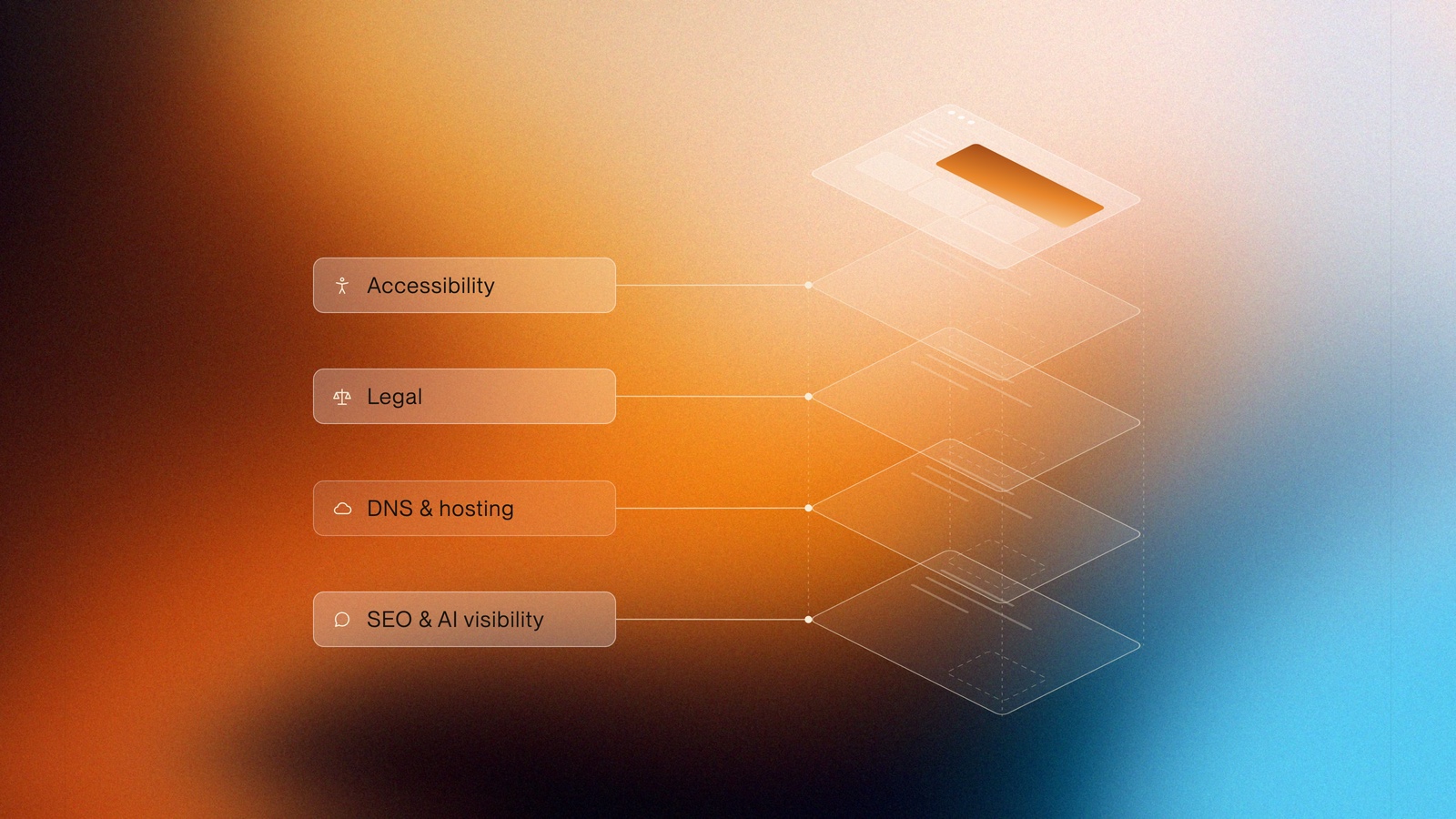
Design and copy are the visible parts of a website. There is a whole layer underneath that many business owners don’t think about, and a typical ChatGPT session won’t raise it unless you ask.
Accessibility. Your site needs to be usable by people with visual impairments, motor limitations, and other disabilities. That means proper contrast ratios, alt text on images, keyboard-navigable menus, and screen-reader-friendly structure. It is not optional goodwill. The ADA applies to websites, and businesses have faced real legal action over sites that were not built with accessibility in mind. AI does not reliably build for this by default.
Legal exposure. A real business website needs a Privacy Policy, Terms of Use, and depending on what you collect, cookie consent that actually holds up. If you are a larger business serving customers in California, or you handle a lot of Californians’ personal data, you may have CCPA obligations. If you offer services to people in Europe or track European visitors, GDPR enters the picture. Skipping these is not just a technicality. It is a liability. ChatGPT may not flag that unless you ask.
DNS and hosting. Getting a domain pointed at a site correctly, setting up email records so your business email does not land in spam, configuring SSL so browsers do not warn visitors away, and making sure hosting is reliable and fast. None of that is glamorous, and all of it matters. A misconfigured DNS record can make your site invisible or your email undeliverable for days before you notice.
SEO and AI visibility. Being findable on Google is one thing. Increasingly, it is also about being findable by AI tools. Your potential customers are already using AI assistants to find local services and get recommendations. That is helped by structured data, clean semantic markup, fast load times, and content architecture that both search engines and AI models can actually parse and trust. A site assembled from a ChatGPT chat does not come with any of that baked in, and even hosted AI builders that handle the basics won’t make those choices for your business.
The Saw and the Craftsman
The way I explain this to clients is with a saw.
Hand a saw to someone who has never built furniture and ask for a table, and you’ll get something that technically holds your coffee. Hand the same saw to a master craftsman, and the table is simply going to be better.
AI is the saw. Agencies like ours use AI too. The difference is that experience and expertise let us take the same tool significantly farther, with much higher quality, than a typical business owner working alone.
And everyone has the saw now. Your competitors can generate a website in an afternoon too, so simply having one no longer sets you apart. Websites got easier to make. Getting found and getting chosen, in my experience, got more competitive. When a business owner with AI goes up against an experienced designer and marketer using the same AI, it’s not hard to guess which site wins the customer.
So if you have the budget, my recommendation is simple. Skip the long hours of trying to make something that may never achieve your goal, and hire an expert who can use these tools to build something far more likely to.
If you don’t have the budget yet, use AI as a thinking partner. Write down your goals, your customers, and what makes you different before you ever ask it to generate a page. The better your input, the less generic your output.
My Honest Verdict
Can AI make a website? Yes.
Can it make a website that actually helps you move your business forward? Based on everything I see day to day, I’m not convinced that’s likely.
AI is a genuinely useful tool, and it’s also been hyped as an easy fix for problems that still require judgment, taste, and real knowledge of your customers. Getting a site live isn’t the hard part. Building something a stranger trusts enough to pick up the phone still comes down to human thinking.
If you’re weighing this decision for your own business, start with the goal, be honest about what you can judge yourself, and bring in help for the parts you can’t. Your website is often the first handshake a customer gets from you. Make sure it feels like it came from a real person.